Why I Built a Pomodoro Timer for Deep Work (And Why Most Apps Fail)

Most productivity apps fail deep work not through lack of features but through excess of them. Attention residue — the cognitive carryover from prior tasks and distracting stimuli — measurably degrades focus quality. FocusKitty is a Pomodoro timer designed around a single principle: the interface itself should not compete for your attention.
The Problem Is Not Willpower
Every article about deep work eventually arrives at the same prescription: remove distractions, protect long blocks of time, stop multitasking. The advice is correct. The delivery mechanism is broken.
The tools recommended for building this discipline — calendar blockers, focus apps — are themselves built on the same engagement logic that makes distraction inescapable. They notify. They streak. They reward check-ins. They surface progress reports during the session you are trying to protect.
The result is a category of software that markets itself as a concentration aid while operating on the same neurological hooks as the platforms it is supposed to replace.
This is not a design accident. It is a product incentive. Engagement drives retention. Retention drives revenue. Deep work, by its nature, is not engaging to watch.
But there is a more specific and better-documented problem underneath this one.
Attention Residue: The Science of Incomplete Tasks

In 2009, organizational psychologist Sophie Leroy published research introducing the concept of attention residue. The core finding: when people switch from Task A to Task B before Task A is fully resolved, cognitive resources remain partially allocated to the incomplete task. The brain continues to process unfinished work in the background, reducing the attentional bandwidth available for the current task.
This matters for focus tools because most of them are built around interruption by design. A timer application that shows a badge count, surfaces an analytics dashboard mid-session, or emits a sound notification at each interval is not neutral. Each stimulus creates a micro-switch event. Each micro-switch leaves residue.
The Zeigarnik Effect, documented decades earlier by Bluma Zeigarnik, established that unfinished tasks create persistent cognitive tension. The mind returns to them involuntarily. A notification from a focus app does not have to be acted on to leave a trace. The mere perception of an unresolved signal is sufficient.
This creates an irony at the center of most productivity software: the interface meant to help you focus becomes a source of the exact cognitive fragmentation it is designed to prevent.
What Interface Minimalism Actually Does to the Brain
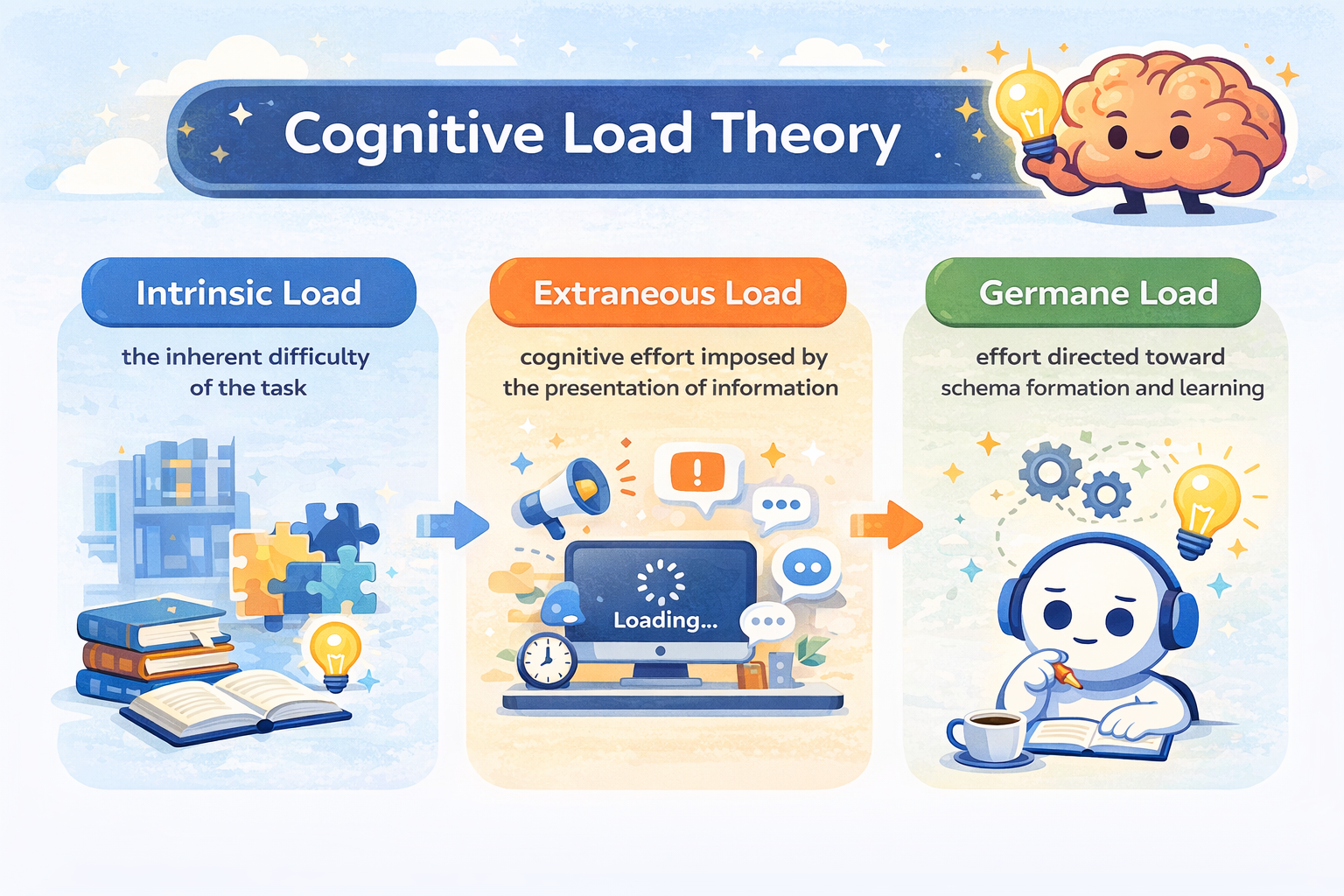
There is a measurable cost to visual complexity. Research in cognitive load theory, developed by John Sweller, distinguishes between:
- Intrinsic load — the inherent difficulty of the task
- Extraneous load — cognitive effort imposed by the presentation of information
- Germane load — effort directed toward schema formation and learning
A productivity app with dashboards, streak counters, motivational copy, animated transitions, and status indicators increases extraneous cognitive load before you have typed a single word. Extraneous load does not just create inefficiency — it actively competes with the neural resources that deep work requires. Working memory is limited. Every element on screen that demands interpretation draws from the same pool.
The practical implication:
a focus tool with a complex interface may deliver a worse deep work experience than a plain stopwatch, regardless of how many productivity features it contains.
Why I Built FocusKitty
I kept abandoning every focus app I tried — not because they lacked features, but because using them felt like work.
The timer was buried behind a dashboard. The session required setup. There was always something to configure, track, or acknowledge before I could start. By the time the timer was running, I had already broken focus twice.
The design principle I kept returning to was simple: the interface should not cost anything. Opening the app and starting a session should require no decisions, no navigation, and no interpretation. The visual field during a session should carry no information that competes with the task at hand.
This is not minimalism as an aesthetic. It is minimalism as a functional constraint — derived directly from what attention residue research says about environmental triggers.
The Architecture of Distraction in Competing Apps
To be specific, here is what most Pomodoro apps do that directly undermines deep work:
Onboarding friction. Configuring session lengths, break patterns, and notification preferences before you can start introduces task-switching before the first focus interval begins.
Persistent progress indicators. Streak counters and session counts are visible during the session itself, not only in post-session reviews. Visible metrics pull attention toward performance evaluation rather than task execution.
Gamification layers. Leaderboards and achievement systems are engagement mechanics borrowed from mobile gaming. They work by creating intermittent reward signals — signals that are, by design, attention-capturing.
Notification redundancy. Apps that send push notifications to remind you to start, combined with in-app sounds and animations at interval transitions, maximize the number of discrete attention events per hour.
Each of these features was likely added because users asked for them, or because they increased daily active usage. None of them are compatible with genuine deep work.
What FocusKitty Does Differently
FocusKitty is built around a single constraint: the interface should be invisible during a session.
The timer runs. The session length is set once. There is no dashboard to navigate to, no streak to check, no notification to dismiss. The visual field is quiet.
The one exception is the Focus Intelligence score — and its design is deliberate. It is a rolling 0–100 score derived from session volume, activity patterns, and consistency over time. It is surfaced after a session, not during one. It is a single number. It does not interrupt.
The analogy I keep returning to is VO2 max. A fitness tracker that shows your VO2 max gives you a meaningful, stable, long-horizon signal about cardiovascular health. It does not flash at you during a run. You train, and the score reflects the aggregate quality of your training over time.
Focus Intelligence works the same way. You work. The score reflects how consistently you are working over time. There is no feedback loop that competes with the session itself.
The Research Case for Ultra-Minimal Design
To synthesize the scientific basis for this approach:
Leroy's attention residue research demonstrates that incomplete task signals degrade concurrent task performance. An interface that generates unresolved signals during a session produces these signals continuously.
Sweller's cognitive load theory establishes that extraneous cognitive load reduces the resources available for intrinsic task processing. A complex interface imposes extraneous load regardless of whether the user consciously attends to it.
Research on ego depletion and decision fatigue (Baumeister et al.) suggests that each micro-decision made during a focus session — whether to check a notification, adjust a setting, or navigate away — draws from a finite pool of self-regulatory resources.
These three bodies of work converge on the same implication: for a focus tool to support deep work, it must minimize the number of signals, decisions, and unresolved stimuli it introduces into the environment. Not reduce. Minimize.
What Ultra-Minimalism Costs (And Why That Is the Point)
There are features FocusKitty does not have that many users ask for. No in-session task list. No motivational quotes on the timer screen. No social component.
These omissions are not oversights. Each would add something to the interface during a session. Each addition would create exactly the kind of low-level attentional noise that attention residue research identifies as harmful.
A focus tool that is also an entertainment platform, a social network, and an analytics dashboard is not a focus tool. It is a productivity-branded interface with the same attentional economics as every other app competing for your time.
The willingness to leave features out is what makes a focus tool a focus tool.
Conclusion
Most Pomodoro apps fail deep work because they are built on engagement metrics, not on cognitive science. Attention residue is real, measurable, and directly worsened by interface complexity. The solution is not a better feature set. The solution is a smaller one.
FocusKitty is built on the premise that the best thing a focus tool can do during your session is nothing. Run the timer. Stay out of the way. Let the work happen.
That is the entire design philosophy. It is also, as far as I can tell, the only design philosophy that is consistent with what the science actually says.
FocusKitty Plus includes Focus Intelligence and Focus Planner, with a 7-day free trial. Try it at focuskitty.app.
Ready to focus deeper?
Try FocusKitty free — beautiful Pomodoro timer with ambient sounds, task planner, and focus stats.
Start focusing for free →